Share Blog:

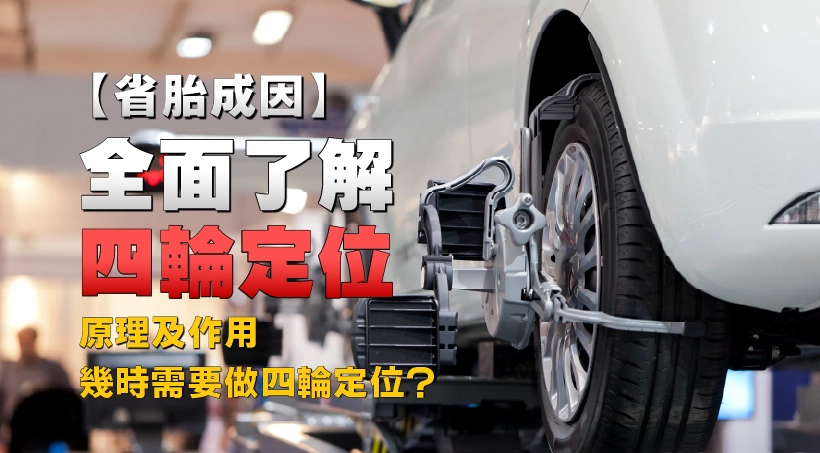
[Reasons for tires wear] Comprehensive understanding of four-wheel alignment | Principles and functions | When is a four-wheel alignment necessary?

【省胎成因】全面了解四輪定位|原理及作用|幾時需要做四輪定位?
Author
Eric Lau
Created On
2025-08-31
Edited On
2026-07-21

Tires erosion is a natural phenomenon, but if the degree of erosion is uneven (commonly known as tire erosion), the cause can be quite complex, involving multiple different components. Wheel alignment can effectively prevent or improve the tire erosion phenomenon. However, this action, which can maintain driving safety and comfort, is often overlooked by many car owners. Kwiksure talks about the basic principles, reasons and timing of four-wheel alignment, as well as common problems.

Table of contents
  • The relationship between tire wear and four-wheel alignment
  • What is a wheel alignment?
  • Why do you need a four-wheel alignment?
  • When is a four-wheel alignment necessary?
  • Preparation before four-wheel alignment
  • Four-wheel alignment and tire balancing
  • Frequently Asked Questions
Related Articles

The relationship between tire wear and four-wheel alignment

[Reasons for tires wear] Comprehensive understanding of four-wheel alignment | Principles and functions | When is a four-wheel alignment necessary?

Although tires is normal for tires to wear out gradually over time. However, if the tires show abnormal or uneven wear, for example, only the tire sidewalls are severely worn, rather than the entire tire surface being evenly worn, it will not only shorten the tire's service life but also affect driving safety. It is absolutely necessary to pay attention to it as soon as possible.

The causes of tire saving are complex, ranging from minor issues like tire pressure to problems with the suspension, braking system, and even the frame. However, we recommend that a simple four-wheel alignment be performed before undertaking costly repairs, as it may resolve the problem.

經快而保買獨立交強險/商業險,出單快捷方便,符合內地需求!

What is a wheel alignment?

Wheel alignment is a technique for adjusting the angles between a car's four tires, the ground, and the vehicle body to maintain optimal geometric relationships. Simply put, it ensures that the tire surface maintains ideal contact with the road surface, whether the wheels are driving straight, turning, or cornering, ensuring driving stability and evenly distributed force on the tires.

Specifically, four-wheel alignment mainly adjusts three angles:

Camber :

[Reasons for tires wear] Comprehensive understanding of four-wheel alignment | Principles and functions | When is a four-wheel alignment necessary?

The angle of inclination of the tire relative to the vertical when viewed from the front of the vehicle. There are two types of camber: positive and negative. Positive camber means the tire tilts outward from the top down (external wear); negative camber means the tire tilts inward from the top down (inner wear).

Toe :

[Reasons for tires wear] Comprehensive understanding of four-wheel alignment | Principles and functions | When is a four-wheel alignment necessary?

The angle between the front wheels relative to each other when viewed from above. Proper adjustment improves straight-line stability and steering responsiveness.

Caster :

[Reasons for tires wear] Comprehensive understanding of four-wheel alignment | Principles and functions | When is a four-wheel alignment necessary?

The angle at which the steering axis tilts forward (positive castor angle) or backward (negative castor angle) when viewed from the side affects the vehicle's straight-line stability and steering self-centering ability.

經快而保買獨立交強險/商業險,出單快捷方便,符合內地需求!

Why do you need a four-wheel alignment?

[Reasons for tires wear] Comprehensive understanding of four-wheel alignment | Principles and functions | When is a four-wheel alignment necessary?

Proper wheel alignment provides numerous benefits for your vehicle. First, it extends tire life, prevents unilateral or localized wear caused by misaligned tire angles, and reduces tire replacement costs. Second, proper alignment reduces drag, lowers fuel consumption, and achieves energy savings.

In terms of safety, four-wheel alignment can ensure that the tires are evenly stressed, improving handling stability and steering flexibility, thereby ensuring driving safety. On the other hand, if four-wheel alignment is neglected, the vehicle may experience steering wheel deviation, vibration during driving, or even body tilt. In severe cases, it may also cause excessive wear on other chassis and suspension parts.

經快而保買獨立交強險/商業險,出單快捷方便,符合內地需求!

When is a four-wheel alignment necessary?

In addition to performing a four-wheel alignment only when uneven tire wear is discovered, we also recommend a four-wheel alignment if the following situations occur:

  • The vehicle veers off course or cannot move in a straight line

  • The steering wheel vibrates or shakes noticeably

  • Frequent driving on roads with many potholes and poor road conditions

經快而保買獨立交強險/商業險,出單快捷方便,符合內地需求!

Preparation before four-wheel alignment

Before performing a four-wheel alignment, check the tire pressure for correct results. Underinflated or overinflated tires can affect the results. Always use professional 3D alignment equipment and follow the manufacturer's specifications to avoid errors caused by making your own judgment.

比較全港逾60間保險公司報價,快而保汽車保險中介為你挑選最符合你要求的車保,立即報價!

Four-wheel alignment and tire balancing

Four-wheel alignment and wheel balancing (commonly known as balancing) are two completely different things. A four-wheel alignment ensures better contact between the tires and the road, while balancing adjusts the weight distribution between the tires and rims to prevent vibration during driving. Generally, after the tires and rims are assembled, the lighter position within the assembly is identified and a lead sheet of appropriate weight is attached to the rim.

比較全港逾60間保險公司報價,快而保汽車保險中介為你挑選最符合你要求的車保,立即報價!

Frequently Asked Questions

Why does my car's steering wheel veer to the left or right?

It may be that the toe angle of the four-wheel alignment is not correct, causing the vehicle to automatically deviate to one side when driving.

Is re-alignment required after replacing suspension system parts?

Yes, the chassis or suspension parts must be repositioned after replacement to avoid driving instability and tire damage.


Contact Kwiksure to get motor insurance quotes

Kwiksure has over 20 years of experience in the car insurance industry, comparing quotes from over 60 insurers in Hong Kong. Use our online quotation tool now to get a free car insurance quote!

The above information is for reference only. Kwiksure takes no responsibility for the accuracy and timeliness of the information. For the coverage, mode of compensation, benefit limit and premium levels of any specific insurance plan, please refer to the relevant policy terms.

Eric Lau
Author
Eric Lau

Eric is a content creator for Kwiksure, responsible for writing articles on various topics such as cars, travel, domestic helpers, etc., striving to provide readers with detailed and practical information.

With over 20 years of experience in the media industry and driving, Eric has worked for several newspapers, magazines, and online media outlets. Apart from his passion for writing, he also enjoys the pleasure that driving brings. On average, he drives over 40,000 kilometers per year.

KS Thumbnail_car-waxing
Car
2026-06-22

Complete Guide to Car Waxing: Costs, Types Analysis, and Recommendations

For car enthusiasts, it’s only natural to want their vehicle to maintain a glossy and polished appearance at all times. However, Hong Kong’s complex environment—such as exhaust fumes, high temperatures, and rain—can gradually cause the car’s surface to become dull without you even noticing. If not properly maintained and protected in time, this can lead to irreversible damage to the car’s paint. To protect the paintwork, car waxing is one of the most cost-effective solutions. However, there is a wide variety of car wax products on the market, with prices ranging from just over a hundred dollars for DIY options to several thousand dollars at professional auto detailing shops. So, how should you choose? What are the differences between traditional waxing and ceramic coating , which has become increasingly popular in recent years? This guide by Kwiksure will walk you through the benefits of car waxing, the different types available, price comparisons, and common questions—helping you choose the most suitable care solution for your vehicle.
【邊部PHEV插電混能好】2026香港PHEV車型盤點|優缺點分析|保養及使用注意事項
Car
2026-06-16

【Which PHEV Plug-in Hybrid is Good】2026 Hong Kong PHEV Model Guide|Pros & Cons Analysis|Maintenance & Usage Precautions

The most talked-about keyword in the local automotive scene in 2026, following the " End of the One-for-One Scheme " early this year, is undoubtedly "PHEV"—which stands for "Plug-in Hybrid Electric Vehicle." Since electric vehicle prices have skyrocketed, PHEV models, which can combat soaring fuel costs without causing range anxiety, have become the primary focus of aggressive promotion by major dealerships. This time, Kwiksure has compiled a list of the latest PHEV models available locally, along with key considerations for purchasing and daily use.
【混能車保養攻略】日系 vs 歐系混能車比較:原理、保養差異|維修成本分析
Car
2026-06-01

【Hybrid Car Maintenance Guide】Japanese vs. European Hybrids Comparison: Principles, Maintenance Differences|Repair Cost Analysis

The end of the "One-for-One" replacement scheme has caused electric vehicle prices to surge, weakening their appeal. However, in the face of persistently high fuel prices , many car brands have recently shifted their focus to heavily promoting hybrid vehicles instead. Whether you are preparing to purchase one or are already a hybrid owner, how do you distinguish between the different types of hybrid cars? How should you maintain a hybrid car? This time, Kwiksure shares with you the characteristics of Japanese and European hybrids, along with a comprehensive hybrid car maintenance guide.
網約車保險
Car
2026-05-26

Ride-Hailing Insurance

Ride-hailing services will be legalized on August 22, 2027. The government has recently submitted a document to the Legislative Council outlining regulatory details for ride-hailing services. These include requirements such as drivers must be at least 21 years old, hold a Hong Kong Permanent Identity Card, possess a driving license for more than one year, have no serious traffic convictions within the past five years, and pass designated assessments and pre-service training courses. It is proposed that, in the initial phase, the number of ride-hailing vehicle licenses be capped at 10,000. In addition, applicant vehicles must be less than 12 years old, must carry third-party liability insurance covering ride-hailing use, and private cars must be registered under an individual’s name (i.e., “fixed driver–vehicle pairing”). These proposals have sparked widespread discussions across various sectors of society. As a stakeholder in Hong Kong’s motor insurance industry, we explore, from different angles, issues affecting private car owners considering entering the ride-hailing industry, including insurance terms, coverage, and premiums.