Share Blog:

Japan Parking Guide: Apps, Types, and Fee Calculation

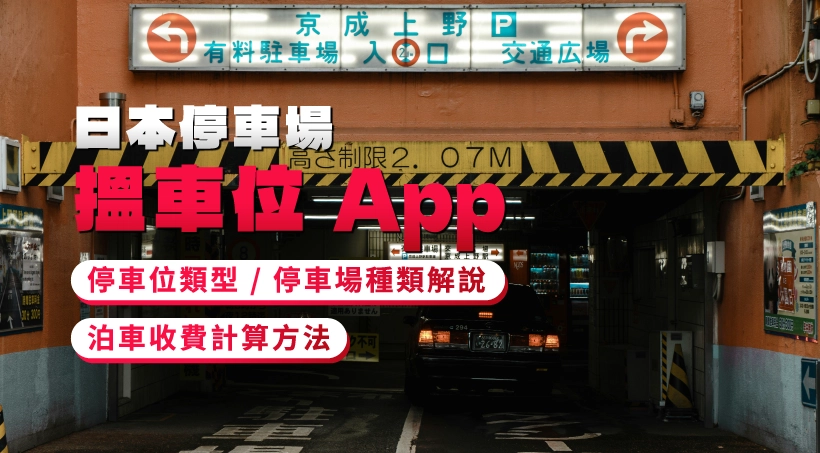
【日本停車場】搵車位 App|停車位類型 / 停車場種類解說|泊車收費計算方法
Author
Eric Lau
Created On
2026-01-11
Edited On
2026-08-03
Text Size

One of the most vexing issues when driving a rental car in Japan is parking! Japan has a wide variety of parking lot types and complex fee structures, and a slight misstep could lead to being "scammed" into paying a high fee. This time, Kwiksure will provide a detailed introduction to common types of parking lots in Japan, methods for calculating fees, and how to easily find an empty spot using a mobile app.


Table of contents
  • Parking Spot Finder Apps
  • Common Types of Parking Lots in Japan
  • Japan Parking Space Types
  • Parking Lot Fee Structure
  • Japan Parking Lot Common Terms List
  • Frequently Asked Questions
Related Articles

Parking Spot Finder Apps

For Hong Kong people driving in Japan for the first time, the first step to finding a parking lot is opening a map. Google Map is the most direct method; simply enter "駐車場" (parking lot) to see nearby spaces. However, the drawback of Google Map is limited information; it usually doesn't show whether a lot is full, and it may not be able to check if credit cards or electronic payments are accepted.

For Apple iPhone users, Apple Map also has quite comprehensive information, especially with synchronization with large Japanese parking companies like Times and Mitsui Repark. It can directly show whether a lot is "Full (満)" or "Empty (空)," which payment methods are supported, and can even link to the official app. If you install both apps, you can see fee and availability information on the map.

Android phone users also have many choices, such as PPPark!akippa, and NAVITIME. These allow you to view the availability and fees of nearby parking lots in the area and can be sorted by distance or price. However, many lots in PPPark! are privately charged, so users need to pay attention. 

KS Travel Insurnace 26% Discount

Common Types of Parking Lots in Japan

Parking types

Usage and Features

Gate-type parking lot

Commonly found in large shopping malls or traditional multi-story/open-air parking lots. The usual practice is to take a ticket upon entry and insert the ticket into the payment machine upon exit to pay and leave.

License plate recognition parking

The entrance area is equipped with cameras that automatically record license plates. When leaving, simply enter the license plate number at the payment machine to confirm the amount and make payment. These types of parking lots are often located in large supermarkets or shopping malls, and some customers can waive part of the fee by showing a parking voucher after making a purchase.

Ground lock parking lot

Mostly used in small, open-air parking lots, a metal locking plate rises from the center of the ground to lock the vehicle after parking, and is lowered only after payment. Before leaving, remember to check that the locking plate has been released to avoid damaging your vehicle when moving it.

Multi-level / lift-type parking garage

This system is commonly used in hotels or commercial buildings, and in some cases, you need to hand over your car keys for staff to operate. When you pick up your car, you show your parking ticket and pay, and the staff will then retrieve the vehicle from the mechanical parking rack. It's safe but more expensive.


Japan Parking Space Types

For tourists, hourly parking lots are the most common. However, before parking, you must pay attention to whether the space has the characters "軽専用" (Kei senyō) or "軽" (Kei). This indicates a dedicated parking space for K-Cars (light vehicles under 660cc, with yellow license plates), and you must not park in the wrong spot.

Additionally, there are several types of parking lots you absolutely must not park in to avoid fines or trouble: Monthly rental parking lots (月極駐車場, Tsukigime chūshajō), private corporate parking lots (often marked with "無断駐車禁止" (Mudanchūsha kinshi, No unauthorized parking); violators may be charged high fines), dedicated merchant parking lots without consumption, and areas with "No Parking" signs on the roadside. Also, "無料案内所 P" (Muryō annai-jo P, Free Information Center P) signs, which denote specific facility parking, should not be parked in unless you intend to patronize that facility.

Parking Lot Fee Structure

Japanese parking lot fee calculation is flexible and varied. The most important keyword is definitely "最大料金 (Saida Ryōkin, Maximum Charge/Cap)," which refers to the highest amount payable within a specific period. For example, if it shows "Maximum ¥800 within 12 hours after entry," it means you only need to pay a maximum of 800 Japanese Yen within that 12-hour period. Pay special attention that some parking lots are marked with "一回限定" (Ikkai Gentei, one-time limit) or "繰り返しなし" (Kurikaeshi nashi, no repetition), meaning this maximum charge can only be used once, and after the specified time limit, the charge reverts to the standard rate (hourly); if it says "繰り返しあり" (Kurikaeshi ari, repetition allowed), it means the maximum charge can be repeated, which is suitable for long-term parking.

Furthermore, some maximum charges have time restrictions, for example, only having a maximum charge from evening to morning, with the rest of the time being charged hourly, or only having a maximum charge on specific days like Sundays and public holidays. The maximum charge can also vary depending on the day of the week and time of day, for example, separate daytime maximum charges or nighttime maximum charges.

The hourly rate is another common trap, where many people only pay attention to the first hour's price but overlook subsequent stages. For instance, "First 60 minutes ¥200, then every 30 minutes ¥100" or "Every 15 minutes ¥300," etc. In terms of time units, besides the common hour and half-hour, some parking lots calculate charges based on every 20 minutes or even every minute.

For Hong Kong people unfamiliar with Japanese, it is recommended to take a photo of the fee sign before parking and use Google Translate to confirm terms like "最大料金," "土・日・祝" (Dō/Nichi/Shuku, Sat/Sun/Holidays), and the explanatory text, to ensure you clearly understand the fee calculation method.

Japan Day of the Week Comparison Table

祝日(しゅくじつ,Shukujitsu)

Public holidays

日曜日(にちようび,Nichiyōbi)

Sunday

月曜日(げつようび,Getsuyōbi)

Monday

火曜日(かようび,Kayōbi)

Tuesday

水曜日(すいようび,Suiyōbi)

Wednesday

木曜日(もくようび,Mokuyōbi)

Thursday

金曜日(きんようび,Kin'yōbi)

Friday

土曜日(どようび,Doyōbi)

Saturday


KS Travel Insurnace 26% Discount

Japan Parking Lot Common Terms List

Japanese

English meaning

Explanation

駐車場 (Chūshajō)

Parking Lot

Parking space for vehicles

軽 (Kei)

Small Vehicle

Parking spaces specifically for K-Car models

基本料金 (Kihon Ryōkin)

Basic Fee

This can be understood as an hourly rental fee; once the time limit is exceeded, the fee will continue to be calculated.

最大料金 (Saida Ryōkin)

Maximum Charge / Fee Cap

Pay attention to the conditions of use, such as the applicable time period and duration.

一回限定 (Ikkai Gentei)

One-time Limit / Applicable Only Once

The maximum fee limit is calculated only once; after the timeout, the basic fee will be added back.

繰り返しあり (Kurikaeshi Ari)

Repetition Allowed

The upper limit can be calculated repeatedly, making it suitable for overnight or multi-day berthing.

繰り返しなし (Kurikaeshi Nashi)

Non-repeatable

It's equivalent to a one-time limit; the charge will increase after the time limit is exceeded.

時間帯最大料金 (Jikantai Saida Ryōkin)

Time Period Maximum Charge

It applies to specific time periods (e.g., there is a limit only from 8 pm to 8 am; normal billing applies at other times).

当日 24 時まで最大料金 (Tōjitsu 24-ji made Saida Ryōkin)

Maximum Charge until 24:00 on the Same Day

Charges are capped at midnight on the day of the event; charges will be recalculated after midnight.

入庫後 (Nyūko-go)

After entering

The calculation starts from the time of entry.

オールタイム (Ōrutaimu)

All Time

Applicable 24/7 (but may have different limits for day and night).

最大料金はございません (Saida Ryōkin wa Gozaimasen)

No Maximum Charge

Long-term parking fees will accumulate, so it is advisable to avoid parking there.


Frequently Asked Questions

How are Japan parking lot fees calculated?

You need to pay attention to the "最大料金 (Saida Ryōkin, Maximum Charge/Cap)" displayed by the parking lot, which refers to the highest amount payable within a specific period. The hourly rate is another common trap, where many people only pay attention to the first hour's price but overlook subsequent stages. In terms of time units, besides the common hour and half-hour, some parking lots calculate charges based on every 20 minutes or even every minute.

What if I lose my parking lot entry ticket?

You can press the "駐車券紛失" (Chūshaken Funshitsu, Lost Parking Ticket) button on the payment machine or contact the parking lot staff. However, you generally need to pay a penalty equivalent to the parking lot's single-day maximum charge, but the handling process varies depending on the regulations of each parking lot.


Contact Kwiksure to get travel insurance

Kwiksure has over 20 years of experience in the travel insurance industry, comparing quotes from over 60 insurers in Hong Kong. Start purchasing your travel insurance plan now!

The above information is for reference only. Kwiksure takes no responsibility for the accuracy and timeliness of the information. For the coverage, mode of compensation, benefit limit and premium levels of any specific insurance plan, please refer to the relevant policy terms.

Eric Lau
Author
Eric Lau

Eric is a content creator for Kwiksure, responsible for writing articles on various topics such as cars, travel, domestic helpers, etc., striving to provide readers with detailed and practical information.

With over 20 years of experience in the media industry and driving, Eric has worked for several newspapers, magazines, and online media outlets. Apart from his passion for writing, he also enjoys the pleasure that driving brings. On average, he drives over 40,000 kilometers per year.

新皇崗口岸懶人包|24小時通關、一地兩檢及公共交通一文睇清
Travel
2026-06-18

New Huanggang Port Guide | 24-hour customs clearance, co-location and public transport in one article

The new Huanggang Port is expected to open as early as July 2026, retaining 24-hour clearance services and adopting a "co-location arrangement" and "cooperative inspection, one-time clearance" model to facilitate cross-border travelers. Kwiksure provides a comprehensive overview of the new Huanggang Port's clearance information, operational model, and public transportation routes, offering the latest news on Shenzhen-Hong Kong border crossings.
【北上過關攻略】即時查看內地關口人流實況|3大必備工具|港車北上、高鐵適用
NTHKV
Travel
2026-04-20

[Guide to Crossing the Border] Real-Time Mainland Border Traffic Monitoring | 3 Essential Tools | For "Northbound Travel for HK Vehicles" & High-Speed Rail

Heading North during holidays has become a major trend for Hongkongers. Want to avoid waiting for hours in suffocating crowds at Lo Wu, Lok Ma Chau, or Shenzhen Bay? Mastering "Real-Time Traffic Inquiries" is a must-have skill for every traveler. Key tools include the " HK Immigration Department App ," " Easy Boundary ," and the WeChat Mini Program " iPort ". Today, Kwiksure introduces these three essential tools to help you track waiting times and ensure a smooth journey between Hong Kong and Mainland China.