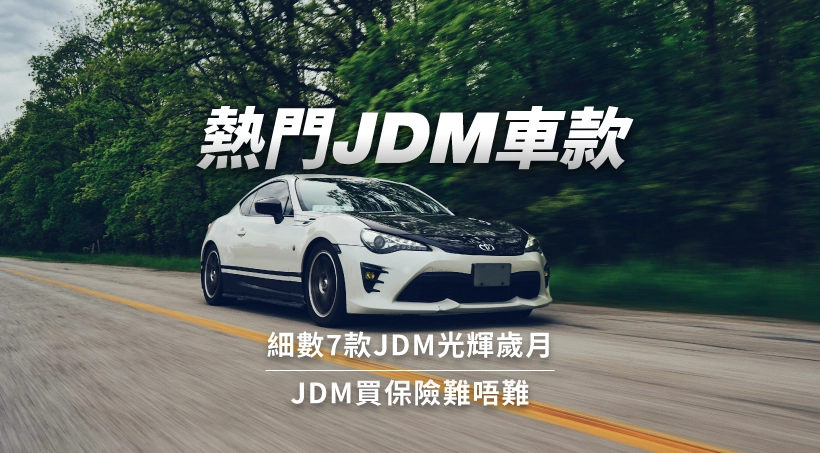
The AE86 model is the Toyota Sprinter Trueno. In 1966, in order to attract young buyers, the manufacturer launched the Sprinter model based on the then-popular family car series Corolla.


Hong Kong people have a special fondness for Japanese cars, especially those that are unique to the Japanese domestic market, commonly known as JDM (Japan Domestic Market). The 1980s and 1990s were the golden years of Japanese cars. Many classic models were highly sought after by Hong Kong car fans, such as the familiar Toyota AE86, Nissan Skyline GT-R, Subaru WRX STi and Subaru etc. This time, Kuai Er Bao will introduce you to some famous JDM cars to see if there is your dream car.
.webp)
The Skyline GT-R was first introduced in the 1960s and was already popular among car fans, but it was not until the third generation (R32) released in 1989 that it truly shocked the automotive industry. At that time, the R32 was equipped with a 2.6-liter twin-turbo straight-six engine (RB26DETT), outputting 280 horsepower, four-wheel drive (ATTESA) and four-wheel steering technology, making it invincible on the track. In the All Japan Touring Car Championship from 1990 to 1993, it set a record of 29 consecutive victories, and not only earned the title of "God of War in Japan", but was also regarded as a national treasure-level sports car.
In 2007, Nissan released the new generation GT-R (R35), which is seen as a continuation of the Skyline GT-R and is equipped with a V6 twin-turbo engine. The initial specifications were 480 ps horsepower and 588 Nm torque, and later evolved to 570 ps horsepower and 637 Nm torque. However, after 17 years and numerous minor modifications, the manufacturer finally announced at the beginning of this year that it would stop producing the R35, mainly because many parts had begun to be discontinued. Although it is estimated that Nissan will still develop the next generation R36, it is very likely to be converted into an electric car. For JDM car fans, the surging engine sound is the reason why GT-R is so charming.
.webp)
In 1992, Subaru launched the first generation WRX (GC8) based on the Impreza series, equipped with a 2-liter horizontally opposed turbo engine. In 1994, the manufacturer launched an upgraded version of the WRX STi to cope with off-road competitions. The redesigned suspension system, four-wheel drive and lightweight design, plus 250 ps horsepower, helped off-road racer Colin McRae win the World Rally Championship (WRC) and the team championship in 1995. At the same time, the WRX STi also performed well in many rally competitions. In the Japanese anime "Initial D", Fujiwara Takumi's father Fujiwara Bunta also drives a WRX STi, which shows the high-performance image of this car in the minds of car fans.
Unfortunately, due to the need to comply with different factors such as exhaust emissions in different parts of the world, the manufacturer announced in 2020 that the WRX will no longer be called STi, but it is still the manufacturer's performance car. The new generation WRX uses the FA24 engine and is equipped with a Turbo and four-wheel drive system. It still adheres to its original intention to launch a manual transmission version, continuing to provide options for car fans who pursue the authentic traditional driving pleasure of Fuji Subaru.
.webp)
The Toyota Supra was born in the 1970s when the Japanese automobile industry entered its heyday. The first generation was designed based on another popular sports car at the time, the Celica, and was called the Celica SUPRA, which was considered an extension of the Celica. In 1981, the second generation SUPRA was launched and separated from Celica to become an independent car series. The engine capacity was increased from 2.6 liters to 2.8 liters.
The third generation SUPRA was released in 1986 (A70), adding many high-tech equipment at the time, such as ABS and electronic suspension system. The fourth generation (A80), which is most familiar to Hong Kong people, was launched in 1993. It changed the streamlined sports car style and added rounded lines. Equipped with a 3-liter straight-six turbo engine numbered 2JZ-GTE, the Japanese version has a horsepower of 280 ps, while the American and European versions have a horsepower of 330 ps.
The fourth-generation SUPRA was discontinued in 2002. It was not until 2019 that the manufacturer re-launched what is considered the fifth-generation SUPRA, which was drastically changed to a sci-fi shape. However, in order to reduce development costs, this generation of SUPRA was jointly developed by Toyota and BMW. Therefore, the specifications of this generation of SUPRA and the BMW Z4 (G29) are very similar, with inline four-cylinder and inline six-cylinder engine versions respectively, with horsepower of 258 ps and 387 ps.
.webp)
From the late 1980s to the 1990s, major Japanese car manufacturers launched high-horsepower sports cars. Honda, which had achieved great success in Formula One, was determined to create a groundbreaking sports car. As a result, the first generation of NSX was born in 1989. The NSX, with its extremely streamlined and low body, was said to be designed to rival the Ferrari 348 at the time, and to have recruited two famous F1 drivers at the time, Ayrton Senna and Ayrton Senna. href="https://zh.wikipedia.org/wiki/%E4%B8%AD%E5%B6%8B%E6%82%9F" rel="noopener noreferrer nofollow" target="_blank">Nakajima Satoru participated in the development, which led to the NSX being called the "Oriental Ferrari".
To pursue the ultimate in vehicle weight, Honda used aluminum alloy to build the frame, connecting rods and engine components, and then used the world-leading VTEC technology and a mid-mounted 3-liter V6 engine layout. Although the first generation was priced at 8 million yen when it was launched, it was still sold out. Later, the price increased to 13 million yen, but orders continued to flow in, resulting in a long waiting period and even a situation where a used NSX was more expensive than the original price.
Unfortunately, as user demand and global economic conditions changed, NSX sales declined significantly. It was reported that annual sales were only 100 units. Finally, Honda announced the discontinuation of NSX in 2005, marking the official end of a generation of classics. Although Honda released the second-generation NSX in 2015 and switched to a hybrid engine, its popularity and sales are no longer as strong as before, and it was discontinued in 2021.
.webp)
The Mazda RX-7, Honda NSX, Nissan Skyline GT-R R34 and Toyota Supra are collectively known as the four major JDMs of the 1990s. The predecessor of the RX-7 was the Cosmo Sport, which was released in 1966. What’s special about it is that it is the world’s first mass-produced model with a rotary engine. Although the rotor technology was originally invented by the Germans in 1954, the patent rights were purchased by Mazda in 1961. After years of research and development, it was successfully mass-produced and naturally became the focus of the automotive industry.
The first model to be named RX-7 was launched in 1978, with naturally aspirated and turbo versions, the turbo offering 165ps of horsepower and a perfect 50:50 body weight. The second generation RX-7, released in 1985, was based on the Porsche 924 and had its horsepower increased to 215 ps. The third generation, which was launched in 1991, had a completely new look with sleek lines and is the generation most familiar to Hong Kong people. The new 13B-REW twin-rotor twin-turbo engine significantly increases horsepower to 280 ps, allowing it to accelerate from 0 to 100 km/h in just 5 seconds. The RX-7 was discontinued in 2001 and was replaced by the RX-8, but it is not as classic as the RX-7.
.webp)
The Lancer, which debuted in the early 1970s, was originally a four-door family car. In the late 1980s, the car was drafted into the World Rally Championship (WRC), replacing the Galant VR-4 and becoming the Lancer Evolution. Since the competition was limited to mass-produced cars, Mitsubishi officially released the Lancer Evolution in 1992, and accidentally wrote a glorious page.
The first generation Lancer Evolution was equipped with a 2-liter inline-four turbo engine transplanted from the Galant VR-4, which output 250 ps of horsepower at 6,000 rpm and 309 Nm of torque at 3,000 rpm. Its powerful performance immediately shocked the automotive industry, and 2,500 units were sold in the Japanese market in just three days. Seeing the unprecedentedly enthusiastic response, the manufacturer naturally would not let go of this goose that lays golden eggs. From 1992 to 2001, in just 7 years, a total of 6 generations of Lancer Evolution were launched. Although there was almost a new generation every year, it was still very popular. Among them, the 5th generation, which underwent a major facelift, not only retained the domineering equipment of the previous generation, such as the hood air intake, large rear wing and round spotlights, but also had tougher body lines. It can be called a contemporary street fighter and is also the most unforgettable generation for many car fans.
Lancer Evolution has gone through 10 generations in total. It is worth mentioning that the last generation was produced from 2007 to 2016. Compared with those years, the update frequency was significantly slowed down, and the sales volume continued to decline, which eventually brought the generation of street car king to an official end.

.webp)
The AE86 craze sparked by the anime "Initial D" has been going on for nearly 30 years, and its influence remains undiminished. The AE86 driven by the protagonist Takumi Fujiwara is a Toyota Sprinter Trueno. Back in 1966, in order to attract young buyers, the manufacturer launched the Sprinter model based on the then-popular family car series Corolla. It had a sporty appearance and more horsepower, and successfully became famous.
From the second generation onwards, Sprinter became an independent car series and was renamed Spirnter Trueno. In 1983, the fifth generation Sprinter Trueno was launched. It was equipped with a 1.6-liter inline-four engine numbered 4AGE, 130 horsepower, a 5-speed gearbox and rear-wheel drive. This is the AE86 that everyone saw in "Initial D". In fact, it is not only "Initial D" that made AE86 so popular. Japanese drift driver Keiichi Tsuchiya often drove AE86 to perform drifting, which also made many people interested in AE86. Due to the anime halo and its age, the second-hand car price of AE86 has reached new highs, and the current asking price is close to HK$400,000.
Insurance companies will consider vehicles 12 years or older as used vehicles and will increase the premiums year by year. These vehicles need to be inspected at the government’s vehicle testing center every year before their vehicle licenses can be renewed. Kuaierbao has a special service for difficult car insurance, which can also help old vehicles.
For car collectors, if the JDM they buy is only for collection purposes and is rarely driven, another option is the so-called "classic car insurance". The car must be at least 20 years old. These policies are designed specifically for classic cars and are very cheap, but they only cover driving within a certain number of mileages.
In 2007, Nissan released the new generation GT-R (R35), which is regarded as the continuation of Skyline GT-R and is equipped with a V6 twin-turbo engine. The initial specifications were 480 ps horsepower and 588 Nm torque, and later evolved to 570 ps horsepower and 637 Nm torque.
The AE86 model is the Toyota Sprinter Trueno. In 1966, in order to attract young buyers, the manufacturer launched the Sprinter model based on the then-popular family car series Corolla.
Kwiksure has over 20 years of experience in the car insurance industry, comparing quotes from over 60 insurers in Hong Kong. Use our online quotation tool now to get a free car insurance quote!
The above information is for reference only. Kwiksure takes no responsibility for the accuracy and timeliness of the information. For the coverage, mode of compensation, benefit limit and premium levels of any specific insurance plan, please refer to the relevant policy terms.
Subscribe Now