


7 motorcycle maintenance tips

Riding a motorcycle is different from driving a car. People, especially men, love it as it is easier to park, uses less gas, and takes up less space. Most motorcyclists also enjoy the feeling of zipping between cars. And like most automobiles, motorcycles also require regular check-ups to stay in tip-top shape. After all, a bike in good running conditions also ensures problem-free riding.
In this Kwiksure article, our experts will share a few insider tips on how to manually inspect your toy.
- Oil
- Tires
- Brakes
- -
- -
- Air filter
- Battery
- Spark plug
Oil
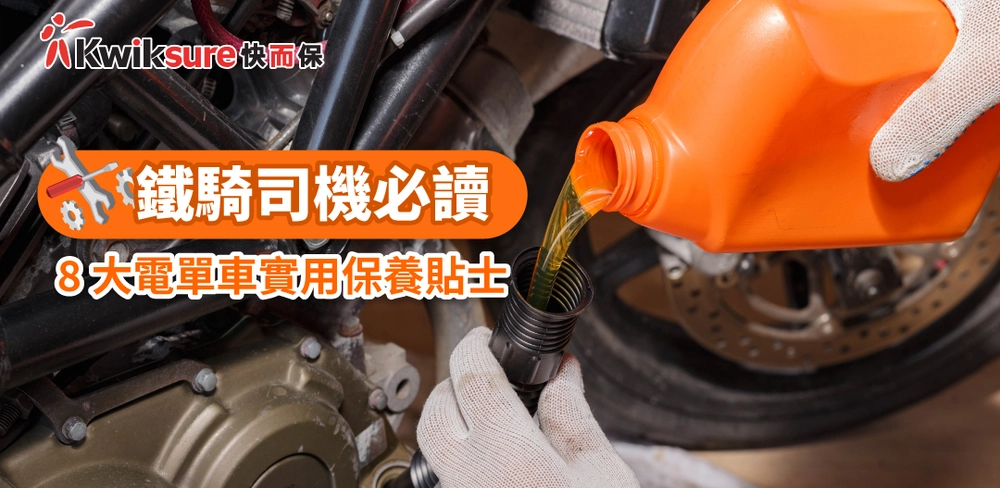
You can refer to your manual for how often you should change your oil, but it is advised that you should do so at least once a year. Should you ride on the motorcycle frequently, you may have to change it more frequently - usually every 5,000 or 10,000km, depending on the model of the motorcycle. Additionally, you can find out the grade of engine oil your bike needs in your user manual. If you pour the wrong grade of engine oil, it can damage your engine in many ways.
Take note of the seasonal differences in oil consumption. In summer, the bike will use more oil, while in winter, the oil will last longer. Lastly, always check your oil level before starting your engine.
Tires
It can be very dangerous if the pressure of your tires is too low or too high. So before you hit the road, you should check the air pressure and the tread with a pressure gauge, and look out for any signs of wear and tear to avoid blowouts. Remember that you should do so when the bike is cool instead of during a ride. This is because only cold tires will show accurately the actual air pressure and so indicates the amount of air needed to inflate the tires fully; while hot tires show a bump in the air pressure due to the increased heat inside them.
Brakes
First and foremost, brakes can be life-saving at critical junctures so it pays to test your brakes before each ride, to ascertain that they are in good order. This also means checking the brake fluid level and the thickness of your brake pads. To keep your brakes at their optimum performance, brake fluid should be replaced every one to two years, depending on the instructions in your manual.
-
-
-
-
Air filter
Clean your air filter with compressed air or replace a new one if necessary. This is particularly important if you ride on dusty roads often. If an air filter is dirty, doesn’t fit correctly or isn’t properly oiled, dirt and grit can go into the engine. Conversely, a clean air filter will give your bike more power.
Battery
Keep your battery charged to 100% with a trickle charger while not in use to extend its lifespan. If you wait until a battery is completely exhausted to charge it, it will have worse performance. You should also inspect your battery every month to make sure that terminals are clean, the connectors on the terminals are not loose, and the electrolyte level is not too low. If it is low, add distilled or deionized water.
Spark plug
Spark plugs deliver electric current to ignite the compressed fuel/air mixture whilst containing combustion pressure within the engine. If they are dirty, collect soot, or badly corroded, then they need to be replaced as soon as possible to avoid complete wear-out.
Before you conduct any check-ups of the spark plug, you should wait at least two hours for the engine to cool down. Dust off the old spark plugs and unscrew with a spark plug socket and ratchet. The color of your spark plug should be light brown. If it’s black, the air and fuel mixture is too rich; if it’s white, the oil-air mixture is too lean and your engine is overheating. In both cases, you will need to get your fuel injection or carburetor checked.