Share Blog:

Mainland China Road Trip: Top 10 Questions and Essential Driving Rules

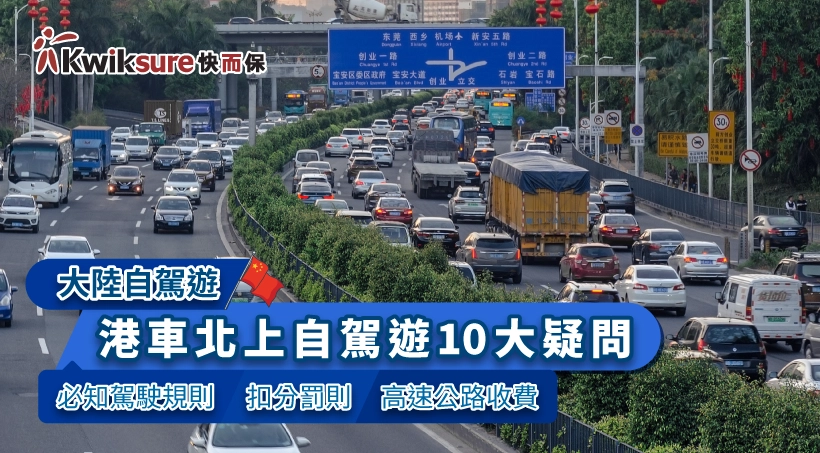
大陸自駕遊】港車北上自駕遊10大疑問 必知駕駛規則|扣分罰則|高速公路收費
Author
Eric Lau
Created On
2024-02-22
Edited On
2026-08-05

When it comes to road trips, most people think of places like Japan, Thailand, and Taiwan. However, with more Hong Kong residents driving their own cars north, road trips in Guangdong Province have become a hot topic in recent years.

In addition to the difference in driving direction compared to Hong Kong, Mainland China has many different driving rules, which confuse many Hong Kong drivers. This guide will address the top 10 questions about self-driving in Mainland China and provide essential driving rules and penalties you need to know before heading north.

Table of contents
  • 1. What About Driving Direction and Roundabouts?
  • 2. Can You Turn Right on Red Lights?
  • 3. What to Do at an Intersection Without Traffic Lights?
  • 4. Is It Safest to Drive on the Right?
  • 5. How Are Lanes Marked?
  • 6. Do Lane Directions Change?
  • 7. Do Lanes Change Direction at Different Times of Day?
  • 8. How to Make a U-Turn?
  • 9. How to Identify Pedestrian Crossings?
  • 10. Can You Use Bus Lanes?
  • Mainland China Driving Violations and Penalties
  • Mainland China Highway Toll/Payment Methods
  • Mainland China Parking Tips
Related Articles
經快而保買獨立交強險/商業險,出單快捷方便,符合內地需求!

1. What About Driving Direction and Roundabouts?

One of the most well-known rules in Mainland China is the left-hand drive. The most important thing to note is that the driving direction will change from Hong Kong's left-hand traffic to right-hand traffic, with the leftmost lane being the "fast lane." If you want to overtake the vehicle in front, you should do so in the left lane. Additionally, when entering and exiting roundabouts, you'll need to drive in a counter-clockwise direction, which is the opposite of the clockwise direction in Hong Kong. For drivers new to left-hand drive vehicles, it is advisable to slow down and pay close attention to other vehicles to adjust more easily.

比較全港逾60間保險公司報價,快而保汽車保險中介為你挑選最符合你要求的車保,立即報價!

2. Can You Turn Right on Red Lights?

In Mainland China, you can turn right at a red light as long as you do not obstruct other vehicles or pedestrians, provided the traffic light is circular. However, for straight or left turns, you must wait for a green light. If the traffic light is an arrow, you must follow the direction indicated by the arrow.

經快而保買獨立交強險/商業險,出單快捷方便,符合內地需求!

3. What to Do at an Intersection Without Traffic Lights?

At a crossroad without traffic lights where you need to turn left, remember the principle of "first go straight, then turn." Allow vehicles going straight from the opposite direction to pass before making your left turn.

比較全港逾60間保險公司報價,快而保汽車保險中介為你挑選最符合你要求的車保,立即報價!

4. Is It Safest to Drive on the Right?

Since Mainland China uses right-hand driving, the rightmost lane is often the slow lane. However, driving too close to the right is not always safest. Many small motorcycles travel on the far right, and there are often exits and entry points from the right. Driving in the second lane from the right can be safer and make it easier to turn left when needed.

比較全港逾60間保險公司報價,快而保汽車保險中介為你挑選最符合你要求的車保,立即報價!

5. How Are Lanes Marked?

In Hong Kong, double white lines signify no crossing, but in Mainland China, single white lines indicate this prohibition. Single yellow and double yellow lines are used to separate opposing traffic lanes and are also no-crossing zones.

比較全港逾60間保險公司報價,快而保汽車保險中介為你挑選最符合你要求的車保,立即報價!

6. Do Lane Directions Change?

Unlike Hong Kong where lane directions are fixed, Mainland China has variable lanes that can change based on traffic conditions. Lane direction changes are usually indicated by road signs in advance, so just pay close attention to the signs.

比較全港逾60間保險公司報價,快而保汽車保險中介為你挑選最符合你要求的車保,立即報價!

7. Do Lanes Change Direction at Different Times of Day?

In addition to variable lanes, Mainland China has tidal lanes indicated by double yellow dashed lines. These lanes may change direction at different times of the day or during special periods. Drivers should pay attention to traffic lights to avoid driving in the wrong direction.

比較全港逾60間保險公司報價,快而保汽車保險中介為你挑選最符合你要求的車保,立即報價!

8. How to Make a U-Turn?

In Hong Kong, you need to be in the rightmost lane to make a U-turn. In Mainland China, dedicated U-turn lanes are often marked, but they may not always be in the leftmost lane; sometimes they are in the middle lanes. U-turn lanes may also be located under bridges, and there may be separate lanes for large and small vehicles, so watch for road signs.

比較全港逾60間保險公司報價,快而保汽車保險中介為你挑選最符合你要求的車保,立即報價!

9. How to Identify Pedestrian Crossings?

Pedestrian crossings in Mainland China might not have dedicated pedestrian lights or the yellow pedestrian crossing lights common in Hong Kong. Instead, white diamond markings are painted on the road near pedestrian crossings. Additionally, there are yellow flashing pedestrian crossing signs on the roadside, though these may be obscured by trees.

港車北上?即經快而保買交強險/商業險!符合內地保險需求!

10. Can You Use Bus Lanes?

Like Hong Kong, Mainland China has bus lanes reserved for buses. These lanes are usually on the far right of the road. You can drive over bus lanes when making a right turn into a side street or when entering or exiting buildings.

比較全港逾60間保險公司報價,快而保汽車保險中介為你挑選最符合你要求的車保,立即報價!

Mainland China Driving Violations and Penalties

Since April 1, 2022, Mainland China has implemented a points-based system similar to Hong Kong's for traffic violations. The system uses a 12-point scale, with points reset annually. Note that speeding is calculated as a percentage over the speed limit rather than the absolute speed. Key violations and their points are as follows:

Speeding

Over 20% but less than 50% of the speed limit on non-highway roads

3 points

Over 20% but less than 50% of the speed limit on highways

6 points

Over 50% of the speed limit on non-highway roads

6 points

Over 50% of the speed limit on highways

12 points


12-point Violations (Partial List)

Drunk driving

Leaving the scene of an accident causing injury or death without reporting to authorities

9-point Violations (Partial List)

Carrying more than 50% but less than 100% above the vehicle’s rated capacity.

Operating a vehicle without displaying license plates or intentionally obscuring them.

6 Points Violations (Partial List)

Disregarding traffic light signals.

Operating a vehicle without a valid driving license.

Using emergency lanes on highways for non-emergency purposes.

3 Points Violation (Partial List)

Not following lane rules: Failing to drive in the designated lane.

Using a mobile phone while driving: Operating a mobile phone while driving.

Failing to yield to pedestrians at crosswalks: Not giving way to pedestrians at pedestrian crossings.

Driving below the minimum speed on highways: Driving below the minimum speed limit on highways.

1 Point Violations (Partial List)

Not using vehicle lights as required: Failing to use headlights or other required vehicle lights.

Violating traffic signs: Disregarding road signs.

Illegal vehicle modifications: Making unauthorized modifications to a vehicle.


記 12 分事項(部分)

酒後駕駛

造成他人輕傷以上或死亡的交通事故後未有報警並離開意外現場

記 9 分事項(部分)

七人車超載人數逾 50% 未及 100%

未有懸掛車牌或故意遮擋車牌

記 6 分事項(部分)

違反交通燈號

未持有有效駕駛證駕駛車輛

高速公路上違法使用緊急車道

記 3 分事項(部分)

不按車道行駛

駕駛時使用手提電話

駛經行人過路處沒有讓行人先行

高速公路以低於最低車速行駛

記 1 分事項(部分)

不按規定使用車燈

違反交通標誌

非法改裝車輛

港車北上?即經快而保買交強險/商業險!符合內地保險需求!

Mainland China Highway Toll/Payment Methods

Unless you are only traveling within the city, most self-drive tours will involve driving on highways, so understanding tolls and payment methods is essential. 

Highway tolls in Mainland China are based on distance. For example, in Guangdong Province, the toll for cars with fewer than nine seats is ¥0.45 per kilometer on four-lane highways and ¥0.60 per kilometer on highways with six lanes or more. You can check highway tolls in advance through apps like "Yue Tong Card ETC," WeChat, Gaode Maps, or Baidu Maps.

At highway exits, there are both manual and ETC lanes. Vehicles with ETC devices can use the ETC lanes, while others must use the manual lanes to pay. Entering an ETC lane by mistake may result in a fine.

比較全港逾60間保險公司報價,快而保汽車保險中介為你挑選最符合你要求的車保,立即報價!

Mainland China Parking Tips

Most parking lots in Mainland China have automatic scanning systems that record license plate numbers upon entry. However, some parking lots may not recognize Hong Kong license plates and may require assistance from staff. Parking fees in urban areas typically range from ¥5 to ¥8 per hour. When leaving, a QR code will be displayed for payment, which can be settled via Alipay or WeChat Pay, so make sure to have these payment systems activated on your phone.

比較全港逾60間保險公司報價,快而保汽車保險中介為你挑選最符合你要求的車保,立即報價!

Contact Kwiksure to get Hong Kong-Zhuhai-Macao Bridge Motor InsuranceHong Kong-Zhuhai-Macao Bridge Motor Insurance quotes

Kwiksure has over 20 years of experience in the Hong Kong-Zhuhai-Macao Bridge Motor insurance industry, comparing quotes from over 60 insurers in Hong Kong. Use our online quotation tool now to get a free Hong Kong-Zhuhai-Macao Bridge Motor Insurance quote!

The above information is for reference only. Kwiksure takes no responsibility for the accuracy and timeliness of the information. For the coverage, mode of compensation, benefit limit and premium levels of any specific insurance plan, please refer to the relevant policy terms.

Eric Lau
Author
Eric Lau

Eric is a content creator for Kwiksure, responsible for writing articles on various topics such as cars, travel, domestic helpers, etc., striving to provide readers with detailed and practical information.

With over 20 years of experience in the media industry and driving, Eric has worked for several newspapers, magazines, and online media outlets. Apart from his passion for writing, he also enjoys the pleasure that driving brings. On average, he drives over 40,000 kilometers per year.

【北上過關攻略】即時查看內地關口人流實況|3大必備工具|港車北上、高鐵適用
NTHKV
Travel
2026-04-20

[Guide to Crossing the Border] Real-Time Mainland Border Traffic Monitoring | 3 Essential Tools | For "Northbound Travel for HK Vehicles" & High-Speed Rail

Heading North during holidays has become a major trend for Hongkongers. Want to avoid waiting for hours in suffocating crowds at Lo Wu, Lok Ma Chau, or Shenzhen Bay? Mastering "Real-Time Traffic Inquiries" is a must-have skill for every traveler. Key tools include the " HK Immigration Department App ," " Easy Boundary ," and the WeChat Mini Program " iPort ". Today, Kwiksure introduces these three essential tools to help you track waiting times and ensure a smooth journey between Hong Kong and Mainland China.
【香園圍口岸泊車】露天停車場攻略|松記停車場|綽德停車場|佳棋停車場|迅領停車場|時租日泊收費
NTHKV
2025-09-07

[Parking at Heung Yuen Wai Boundary Control Point] Guide to open-air parking lots

Heung Yuen Wai Port parking spaces are hard to come by. Even though there is a reservation system , it is often fully booked. As a result, many drivers choose to park at the outdoor car parks (vacant lots) next to Heung Yuen Wai Port. This time, Kwiksure shares information on how to get to the outdoor car parks at Heung Yuen Wai Port and their charges.
Hong Kong’s new bridge: what might this mean for your car insurance coverage?
NTHKV
2025-08-10

Hong Kong’s new bridge: what might this mean for your car insurance coverage?

The new Hong Kong-Zhuhai-Macau Bridge is expected to be completed this month. Set to be the world’s longest sea bridge, it links Hong Kong, Zhuhai, and Macau via 55km of raised road and undersea tunnels. What would previously had been a three hour travel time will be cut to just 30 minutes, further connecting the cities in the Pearl River Delta without impacting the busy shipping lanes of the Lindingyang channel. While people temper their excitement for the opening of the new roadway, some might be asking: how will Hong Kong’s new bridge work with my car insurance? This week, Kwiksure examines how this new superstructure might affect car coverage.
跨境駕駛小貼士:在內地駕駛右軚車
NTHKV
2025-07-04

Tips for driving a right-hand drive car in China

The long awaited, yet regularly delayed Hong Kong-Zhuhai-Macao Bridge is supposedly set to open by the end of 2017. While this is certainly good news, there is one thing to think about: which side of the road the traffic will drive on. As this article in the HKFP discusses, it might be on the right. Due to this, there is a good chance that Hong Kong and Macau drivers will need to get used to driving on the other side of the road. To help, here are six tips you can employ when driving a right-hand (RHD) drive car on the right side of the road.
粵車南下 l 兩階段實施時間表/申請方法/費用/行車範圍
NTHKV
2025-06-29

Guangdong Vehicles Entering Hong Kong: Implementation Schedule, Application Method, Fees, and Driving Range

Since the introduction of the 'Hong Kong Vehicles Northbound' plan, the response has been very positive. The Hong Kong government has recently indicated that it is considering shortening the reservation period to facilitate travel between Hong Kong and Guangdong Province. At the same time, details of the 'Guangdong Vehicles Southbound' plan have been revealed. The plan will be implemented in two phases. Here’s a breakdown of the implementation schedule, application method, fees, and driving range for Guangdong vehicles entering Hong Kong:
Three ways to deal with a car crash in the mainland|Third party injured|Insurance help|Guide to seeking medical treatment in the north
NTHKV
2025-06-29

【Northbound Travel for Hong Kong Vehicles】Steps to deal with three situations of self-driving car crashes in the China | Third party injury | Insurance help | Guide to seeking medical treatment in the north

Northbound Travel for Hong Kong Vehicles are becoming more and more popular and have become a holiday activity for many Hong Kong people. Accidents are unpredictable. If you unfortunately encounter a traffic accident while driving in the Mainland, what should you do? Is the basic compulsory traffic insurance sufficient to pay the compensation? This time, the experts from Kuai Er Bao will analyze with you the steps to deal with different situations when a car crash occurs in the Mainland, and also attach a guide to seeking medical treatment in the Mainland in case of emergency.